

Ailingo case study
Reinventing how people learn English, with an AI tutor in their pocket
Ailingo is a mobile app that helps English learners practice every language skill and hold real conversations with an AI agent. A team project where I led the UX research and design, from the first problem to a high-fidelity prototype.
Role
AI Product Designer
Team
3 designers
Duration
3 months
Year
2024
00
Overview
English learners face three problems at once: the high cost of personal tutoring, generic materials that do not adapt to them, and almost no chance to practice real-world speaking.
Ailingo is our answer. An AI-powered app that gives every learner a personalized, low-cost tutor, with tailored lessons across reading, speaking, listening, and writing, plus real-time conversation practice with an AI agent. I worked with two teammates and led the UX research and design from problem to high-fidelity prototype.
61
surveyresponses
12
userinterviews
$2k+
yearly Englishspend
4
languageskills
01
The problem
English is studied by an estimated 400 million people in China, one of the largest learner populations in the world. Yet most of them hit the same walls on the way to fluency.
400M
people in China learning English, by widely cited estimates
1 in 4
of the country's population has studied English at some point
Tutoring is expensive
Personalized instruction and tutoring cost more than most families can sustain.
Materials do not adapt
Lessons are generic and rarely match a learner's level, interests, or goals.
No real practice
There are few chances for meaningful, real-world speaking practice.
02
Desk research
We started in the literature, to understand why traditional English learning falls short before designing anything.
“Lack of communication skills, limited practical application, boredom and disengagement, lack of critical thinking, unauthentic contexts, fear of making mistakes, and non-interactive classrooms are all drawbacks of traditional methods of teaching English.”
“Learning a second language not only requires practicing linguistic forms, but also becoming familiar with the culture of the target language in order to interpret intercultural communication.”
$2k–4k
spent per family each year on English lessons
15%
yearly growth in English-learning spend
What desk research told us
Money, culture, materials, and practice are the four walls between learners and fluency.
03
Primary research
To hear it from learners directly, we ran a survey with 61 people learning English, aged 16 to 28.
- 30% said oral expression is their biggest challenge in learning English.
- 57.4% said a lack of chances to practice hurts their motivation.
- 62.3% wanted practice adjusted to their level, and 60.7% wanted materials matched to their interests.
- 41% wished they had someone to practice speaking with.
04
The pain points
We then interviewed 12 friends who are learning or have learned English, and distilled them into two personas. Across all of it, four pain points kept surfacing.

01
No authentic materials
Little content tailored to a learner's real interests and goals.
02
No room to practice
Few chances to practice speaking in an immersive, real-world setting.
03
Low engagement
Little interaction or engagement in learning, which quietly kills motivation.
04
No personal path
Learning paths that are not personalized and cannot track progress.
05
Why AI
Solving all of these in one product by hand would be impractical, costing too much time and effort. So we added some magic: artificial intelligence.
Personalized and adaptive
AI uses years of language-learning data to tailor content and feedback to each learner's needs.
Rich, authentic resources
Large language models generate quality materials and realistic practice scenarios on demand.
Scalable and affordable
Automating tutoring, content, and feedback makes good learning accessible to far more people.
The bet
Harnessing AI in language learning is like having a linguist in your pocket, adapting and evolving with every word you speak and every sentence you construct.
06
Where we could do better
We studied popular AI language apps and analyzed their strengths and weaknesses, focusing on their AI features. That surfaced four clear openings to do better.

Enhance personalization
An app that dynamically tailors materials and activities to each user's preferences, pace, and goals.
Contextual, real-life learning
Roleplay scenarios like ordering food or casual chats that bridge theory and practice.
Active feedback and correction
An AI tutor giving real-time feedback on speech, grammar, and writing, with clear explanations.
Emotional engagement
Empathetic AI that reads mood and motivation, offering encouragement to keep learners going.
07
The solution
Ailingo brings these openings together into one AI-powered app, built on four ideas.
Conversational learning
A method built around conversation to boost engagement and interaction.
An agent, anytime
A personalized AI agent ready to start a conversation whenever you are.
AI-generated materials
Authentic, resourceful materials generated by AI and tailored to your preferences.
Adaptive learning path
A self-paced path that fits your current level and grows with you.

08
Flow and wireframes
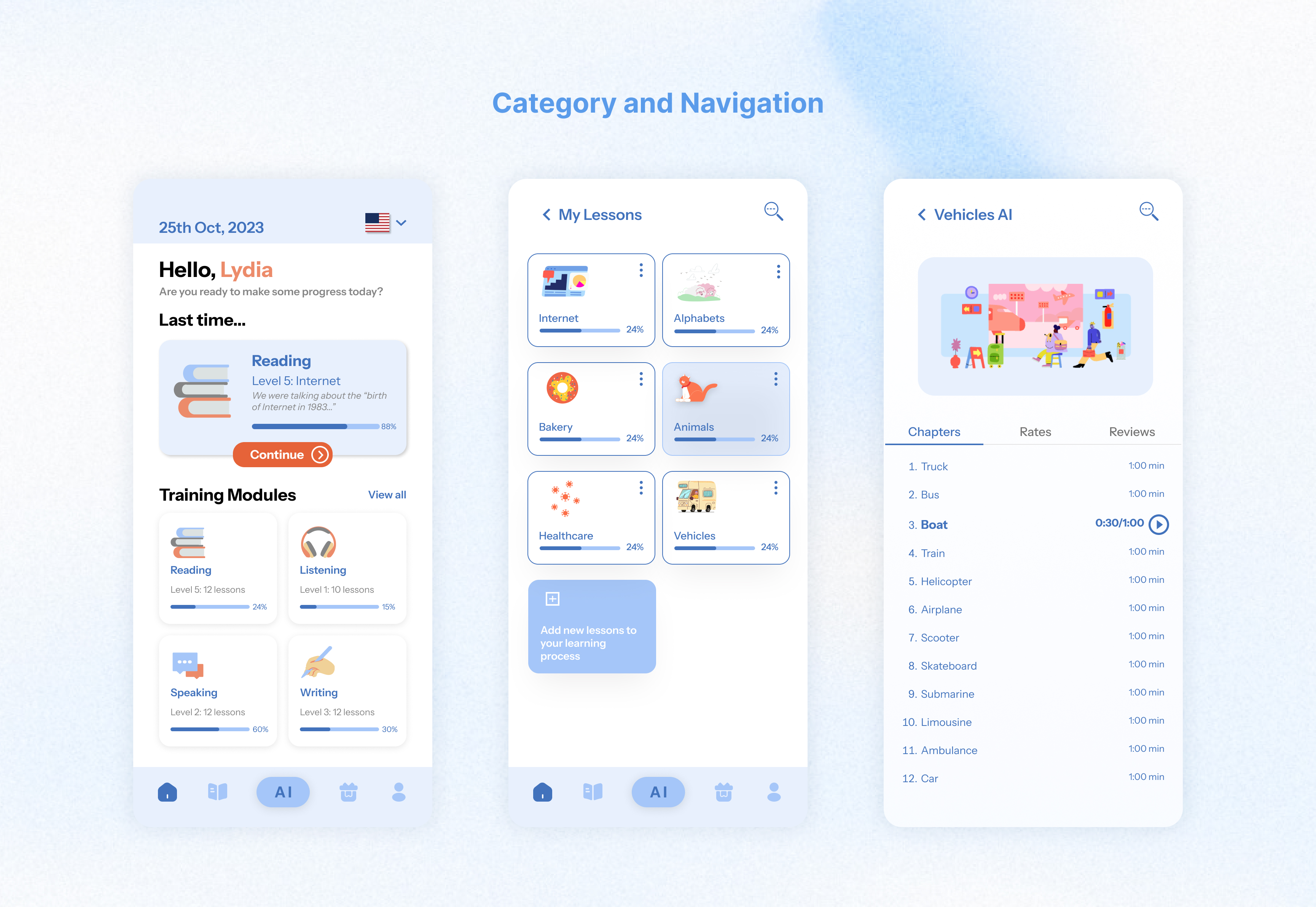
We mapped the features into a user flow, then sketched the core screens across each language skill.

Home
Easy access to classes and topics, organized by level.
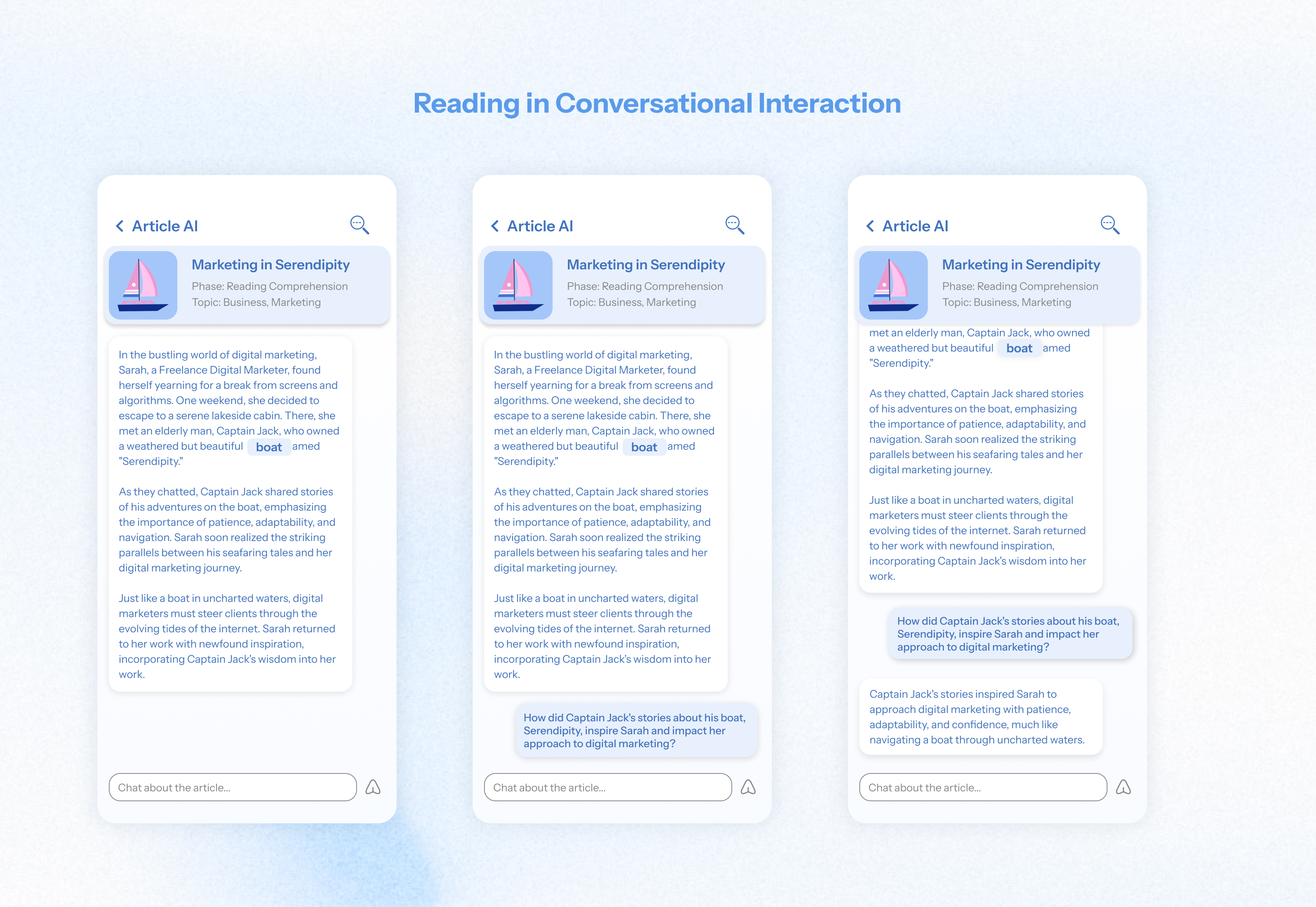
Reading
Read passages and get precise feedback as you go.
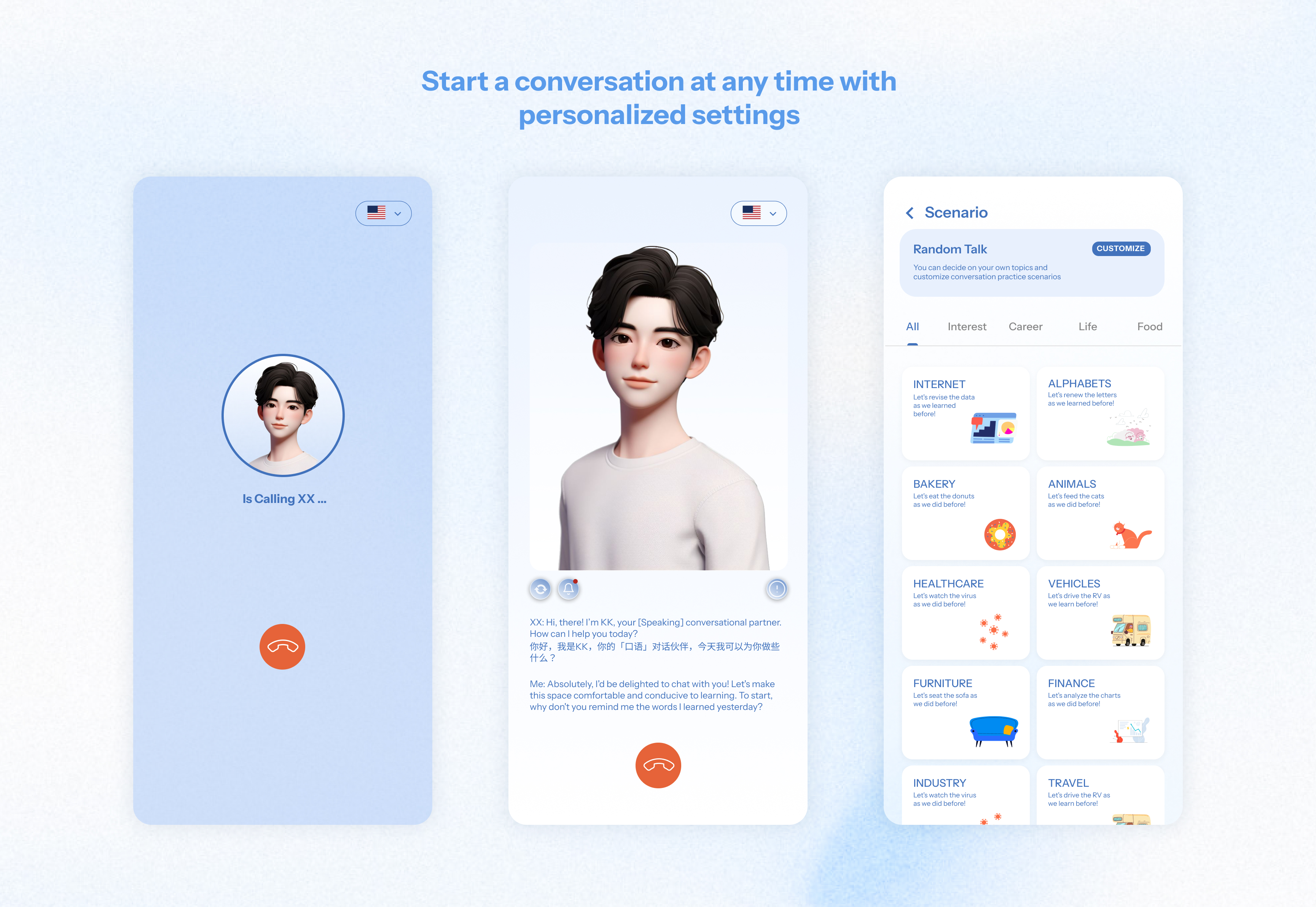
Speaking
Converse with the agent in a personalized context that simulates the real world.
Listening
Practical materials like news reports, with tests that reinforce learning.
Writing
Write to a prompt and get detailed feedback on improvements and revisions.

09
Final design
We crafted the details of every screen for a consistent, calm visual style that makes learning feel pleasant rather than like a chore.

10
What I learned
A few lessons that stuck with me from this project.
01
AI is reshaping how we learn
Its capabilities expanded what I imagined a learning method could be, opening a flexible, adaptive interaction model.
02
Design removes the fear of new tech
When people are new to a technology, clear instructions and feedback before they engage are what bridge the gap.
03
Understand pain points deeply
Immersing myself in learners' perspectives reinforced that every feature should map directly to a real user need.